

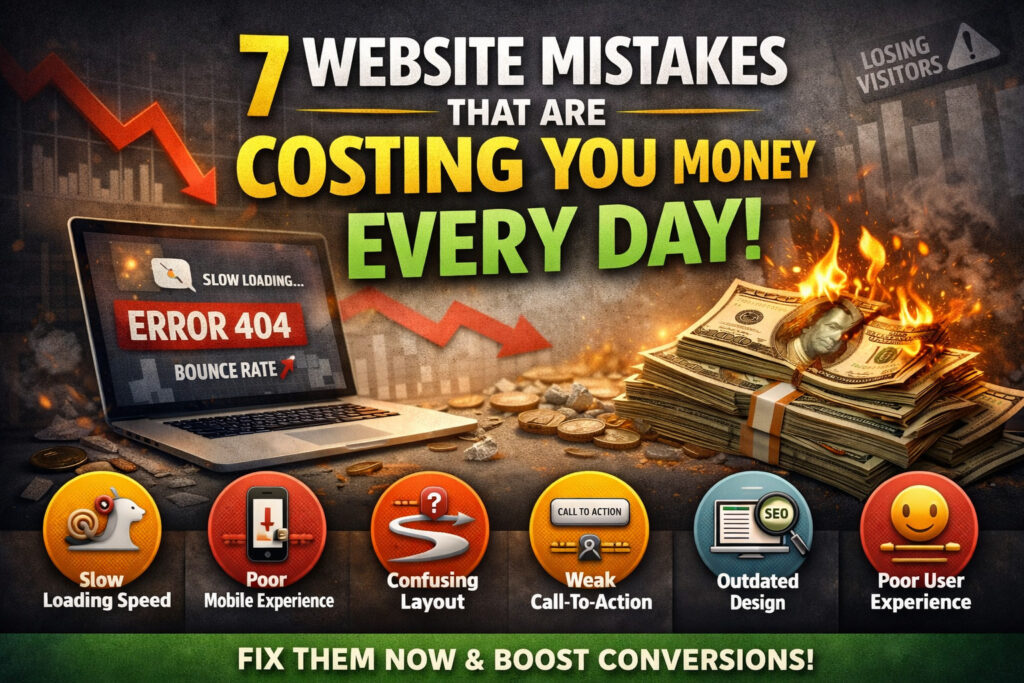
Your Website Is Costing You Money Every Single Day (And You Don’t Even Know It)
Most business owners think launching a website is the final step.
In reality, it’s just the beginning.
A poorly optimized website can quietly damage your business every single day. You may be getting traffic, running ads, or posting on social media — but if your website isn’t built to convert, you are simply losing potential customers.
That’s the hard truth many people ignore.
Why Your Website Is Costing You Money
Every visitor who lands on your website has value. But if they leave without taking action, that opportunity is gone.
Here are some common reasons why your website might be costing you money:
1. Slow Loading Speed
Speed matters more than ever. If your website takes too long to load, users won’t wait. Most people leave within a few seconds, and you lose them before they even see your offer.
2. Poor Mobile Experience
More than half of your visitors are using mobile devices. If your website doesn’t look good or function properly on mobile, you are losing a huge portion of your audience instantly.
3. Confusing Layout
A website should guide users clearly. If visitors don’t understand where to click or what to do next, they will leave without thinking twice.
4. Weak Call-To-Action
If your site doesn’t clearly tell users what action to take, they won’t take any. A strong call-to-action is essential for conversions.
5. Outdated Design
Design builds trust. An outdated or messy design makes your business look unprofessional and unreliable.
6. No Proper SEO
Without SEO, your website is invisible. Even if your site looks great, people won’t find it unless it’s optimized for search engines.
7. Poor User Experience
If your website feels difficult to use, people won’t stay. A smooth, simple experience keeps users engaged and increases the chance of conversion.
How to Fix It and Improve Your Results
The good news is — all these problems can be fixed.
A high-performing website focuses on user experience and conversion. Here’s what you should aim for:
✔ Fast loading speed (under 2 seconds)
✔ Mobile-friendly design
✔ Clean and simple layout
✔ Clear and visible call-to-action
✔ SEO-optimized structure
✔ Easy navigation
When these elements are in place, your website starts working for you instead of against you.
Focus on Conversion, Not Just Trafficwebsite
Many businesses spend money on ads to bring more visitors. But they forget one important thing — if te website doesn’t convert, traffic doesn’t matter.
Improving your website can often bring better results than increasing your marketing budget.
Final Thoughts
Your website is more than just an online presence.
It is your digital salesperson, working 24/7 to attract, engage, and convert visitors.
If it’s not optimized, it’s silently costing you money every single day.
Take the time to fix the issues, improve the experience, and focus on conversion. The results will follow.
Call To Action
Want to find out what’s wrong with your website?
👉 Contact me for a free website audit and I’ll show you exactly what’s holding your site back.
Why Most Online Businesses Fail in the First Year (And How to Avoid It) 2026
1. Thinking a Website Equals a Business
Many beginners believe launching a website means they’re in business.
That’s not true.
A website is just a platform—not a complete system.
Without:
- A clear conversion strategy
- Defined goals
- Optimized user journey
 Your website becomes a static page instead of a revenue machine.
 If you’re serious about building a high-converting site, check your own Web Design Service page ( Add your internal link here)
2. No Clear Target Audience
Trying to serve everyone is one of the fastest ways to fail.
Successful businesses are specific.
They clearly define:
- Who they serve
- What problem they solve
- Why they’re different
When your message is clear, conversions increase.
3. Copy-Paste Business Model
Many people copy competitors or follow trending ideas without understanding the market.
This leads to:
- No uniqueness
- No positioning
- No competitive advantage
Customers don’t choose copies—they choose clarity and value.
read more
